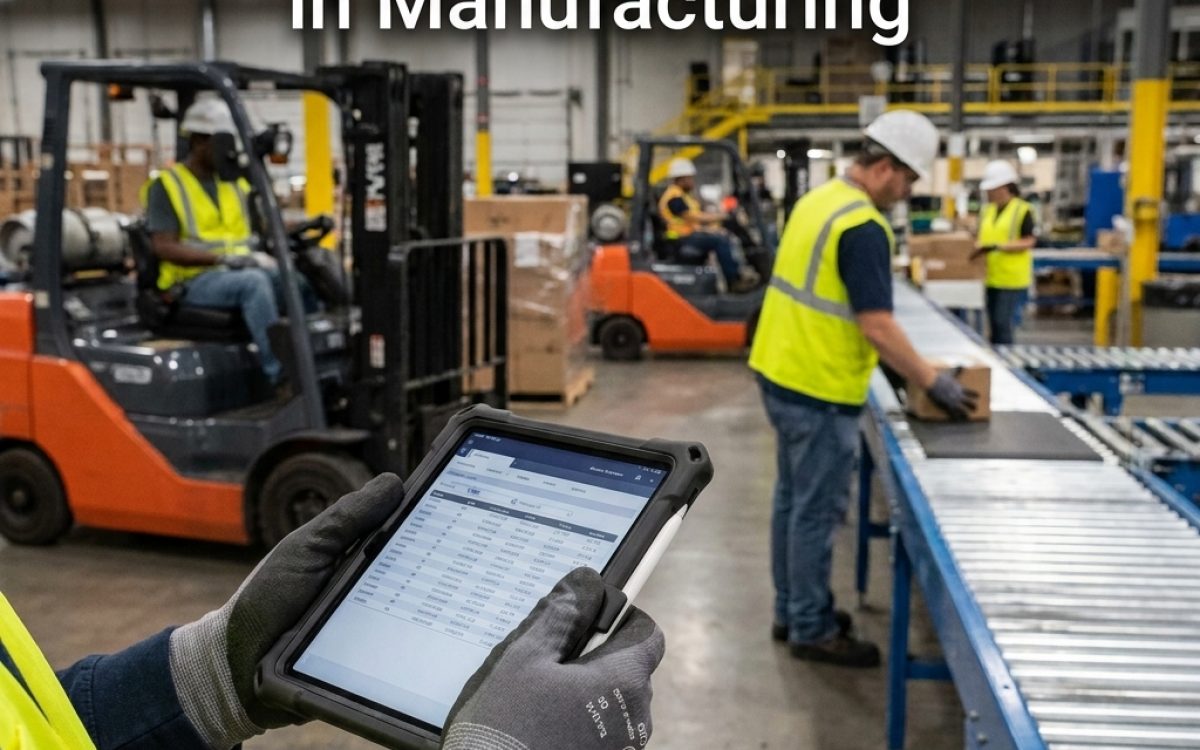
1. Fast-Paced Reality: The High-Stress Environment of Modern Manufacturing
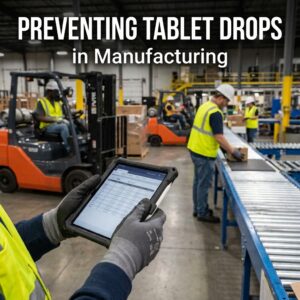
Modern smart factories, fulfillment centers, and high-velocity assembly lines operate at a relentless pace. Frontline personnel work in dynamic environments filled with ambient machinery noise, constant forklift movement, and frequent multi-person interactions. Workers rapidly switch between scanning barcodes, updating Warehouse Management Systems (WMS), completing digital quality sign-offs, and conducting team huddles.
In this fast-moving setting, enterprise tablets such as the Apple iPad and Microsoft Surface Pro serve as vital operational hubs. However, concrete floors, steel racking, and high-frequency physical movements create severe drop risks. While IT departments routinely procure thick shock-absorbing enclosures, passive protection only cushions the impact after a fall occurs. The most effective way to protect mobile hardware and preserve operational uptime is to prevent drops from occurring in the first place.
2. The Biomechanics of Drops: How Pinch Fatigue Drives Device Failures
When an enterprise tablet shatters on a concrete floor, management frequently assumes the incident was caused by simple employee inattention. Ergonomic specialists prove that sustained physical fatigue and improper weight distribution are the primary drivers of handling errors.
Standard tablets force workers to maintain a tight pinch grip using small finger tendons while entering data or scanning assets. According to research from the National Institute for Occupational Safety and Health (NIOSH), repetitive pinch gripping and sustained awkward wrist postures are leading risk factors for musculoskeletal disorders (MSDs). Over an eight-hour shift in a loud, fast-paced plant, hand muscles experience progressive exhaustion. Grip strength plummets, micro-slips occur during sudden movements, and gravity causes the device to fall.
3. Connected Worker Adoption and Behavior-Based Safety
Modern manufacturing leaders understand that software alone does not guarantee a successful digital transformation. As workforce management experts at Redzone emphasize in their industry guidance on behavior-based safety, sustainable facility safety and high productivity depend on building daily physical habits and removing physical friction for frontline operators. When frontline workers encounter physical discomfort or constant device anxiety while using enterprise tablets, user adoption stalls.
Integrating ergonomic accessories transforms passive tablet deployment into an active connected worker strategy. By neutralizing physical handling friction, operators interact with digital work orders, OEE tracking tools, and quality audit apps with complete confidence, reinforcing positive behavior-based safety habits across every shift.
4. Ergonomic Accessories: Eliminating Pinch Strain and Supporting OSHA Rules
Lowering facility drop rates requires altering the physical dynamics of how tablets are held and transported across high-traffic aisles.
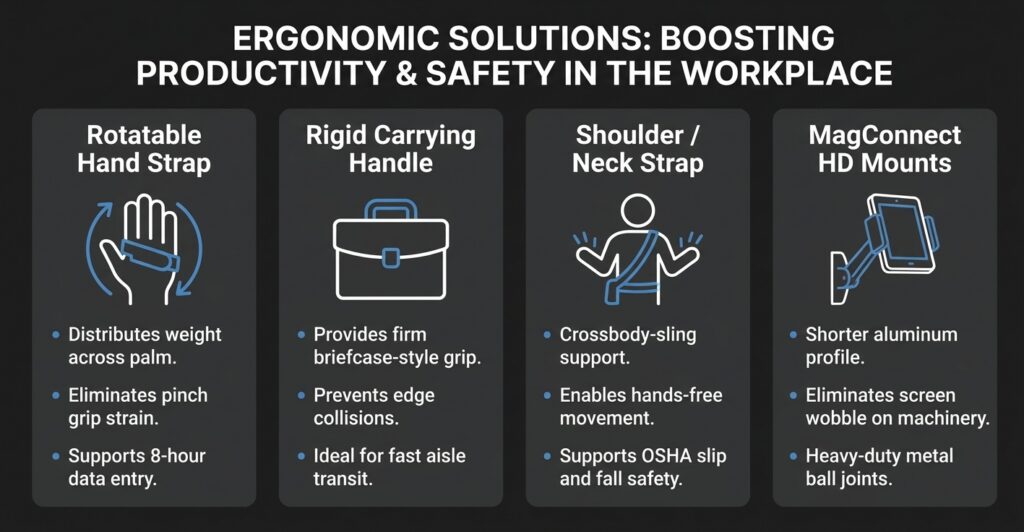
Eliminating the Pinch Grip: Industrial hand straps allow workers to slide their hand flat against the back of the tablet enclosure. Squeezing the bezel is no longer necessary, aligning directly with EHS Today standards for hand strain reduction.
Redistributing Device Mass: A hand strap transfers tablet weight across the palm, wrist, and forearm, engaging larger muscle groups that resist fatigue during long shifts.
360-Degree Rotational Freedom: Fast-paced digital audits require rapid screen orientation shifts. Premium 360-degree rotating hand straps let workers flip between portrait and landscape modes without loosening their primary grip.
OSHA Hands-Free Transit: Carrying handles and adjustable shoulder straps allow devices to be slung across the body or carried briefcase-style. This keeps both hands free when climbing ladders, operating machinery, or walking through busy aisles, complying with OSHA guidelines for slip, trip, and fall prevention.
Ergonomic Architecture & Facility Compliance Matrix
5. Stationary Docking: Why MagConnect HD Outperforms Carbon Fiber on Forklifts
While hand straps protect tablets during walking transit, workers frequently need to dock their devices at stationary workstations, packing lines, material handling carts, or forklifts.
Standard carbon fiber arms offer lightweight strength, but longer carbon fiber arms act as levers that wobble and shake under the heavy vibration of moving forklifts and surrounding machinery. To solve this operational challenge, The Joy Factory recommends MagConnect HD (Heavy Duty) mounting solutions for industrial manufacturing:
Shorter Arm Profiles Eliminate Wobble: MagConnect HD mounts feature shorter aluminum arm lengths that reduce leverage. This prevents screen shaking and keeps displays steady, even on rough warehouse floors or vibrating machine frames.
Heavy-Duty Aluminum Construction: Built with high-gauge aluminum and robust metal ball joints, HD mounts deliver exceptional torsional stiffness designed for high-vibration environments.
Instant One-Second Docking: MagConnect technology combines magnetic alignment with a precision mechanical lock, allowing workers to transition from mounted docking to mobile hand-strap usage in one second.
PROTECT YOUR MOBILE IT INVESTMENT TODAY
Empower your connected workforce with military-grade aXtion cases and MagConnect HD mounts.
Configure Your Solution: Explore The Joy Factory Custom Bundle Builder to select compatible cases, hand straps, and MagConnect HD mounts for your tablet fleet.
Request Evaluation Units: Contact The Joy Factory Sales Team to schedule an enterprise consultation, request test units, or inquire about volume fleet pricing.
Frequently Asked Questions
Q: Why do tablets frequently get dropped in fast-paced manufacturing plants?
A: Drops on assembly lines and warehouse floors are primarily driven by muscle fatigue rather than employee carelessness. Holding a tablet with a constant pinch grip during an 8-hour shift causes finger and forearm strain. Integrating rotating hand straps eliminates pinch strain and prevents drops before they occur.
Q: How does ergonomic device protection support connected worker initiatives and behavior-based safety?
A: Connected worker programs succeed when digital tools feel natural and effortless to use. As highlighted in Redzone’s research on behavior-based safety, removing physical handling friction eliminates device anxiety, encouraging operators to consistently log real-time data, complete digital audits, and maintain high workforce engagement.
Q: Why are MagConnect HD mounts better than carbon fiber arms for forklifts and packing stations?
A: High-vibration environments like forklifts and heavy machinery cause longer carbon fiber arms to act as levers, resulting in display wobble and screen shake. MagConnect HD (Heavy Duty) mounts feature shorter aluminum arm profiles and heavy-gauge metal ball joints that minimize leverage, eliminate shaking, and maintain rock-solid display stability.
Q: How do hand straps help reduce musculoskeletal disorders (MSDs) in industrial workers?
A: Hand straps distribute the tablet’s weight across the palm and forearm instead of forcing finger tendons to maintain a tight pinch grip. This aligns with NIOSH ergonomic guidelines by minimizing repetitive hand strain and awkward postures that lead to MSDs.
Q: How do shoulder straps and carrying handles support OSHA safety compliance?
A: OSHA walking-working surface guidelines emphasize keeping hands free when navigating stairs, ladders, and busy facility aisles. Carrying handles and shoulder straps allow workers to sling their tablets securely, ensuring 3-point contact on ladders and unhindered material handling.