
As digital transformation strategies continue to advance in hazardous locations, a critical debate is emerging regarding device approval.
You’ve likely seen the push for modernizing workflows in the field—equipping workers with tablets and phones to streamline data capture. But this innovation brings a question of liability: Should companies utilize self-certification for these devices, or rely on third-party standards?
You might ask; are companies really taking on this liability on their own and why? Believe it or not, self-certification has been an accepted practice for some companies. The reasons vary—from a lack of certified protective solutions, to administrative burdens and the desire to control end-to-end costs.
However, the debate over this methodology ensues when you consider the overwhelming safety risks presented to people who work in hazardous locations every day. Manual paperwork and compliance documentation certainly need an upgrade, but is self-certification the safest path? Simply put: Is it worth the risk?
1. The Role of “Engineering Judgment”
Proponents of self-certification often cite “Engineering Judgement” (EJ) as a practical approach.
For reference, engineering judgment is the application of an engineer’s extensive knowledge, experience, intuition, and understanding of principles to make sound technical decisions. It is designed to create solutions for unique, complex, or novel situations not explicitly covered by standard codes.
EJ bridges gaps where standard solutions are unavailable or impractical, relying on professional expertise to ensure code compliance. In some distinct cases, this rationale may be sufficient. However, the debate isn’t solely based on the level of expertise or the outcome of the judgment itself. The real question surrounds the dependence on existing industry standards that already provide certified proof-of-performance.
2. Why Third-Party Certification Matters
When lives are on the line, exacting standards matter.
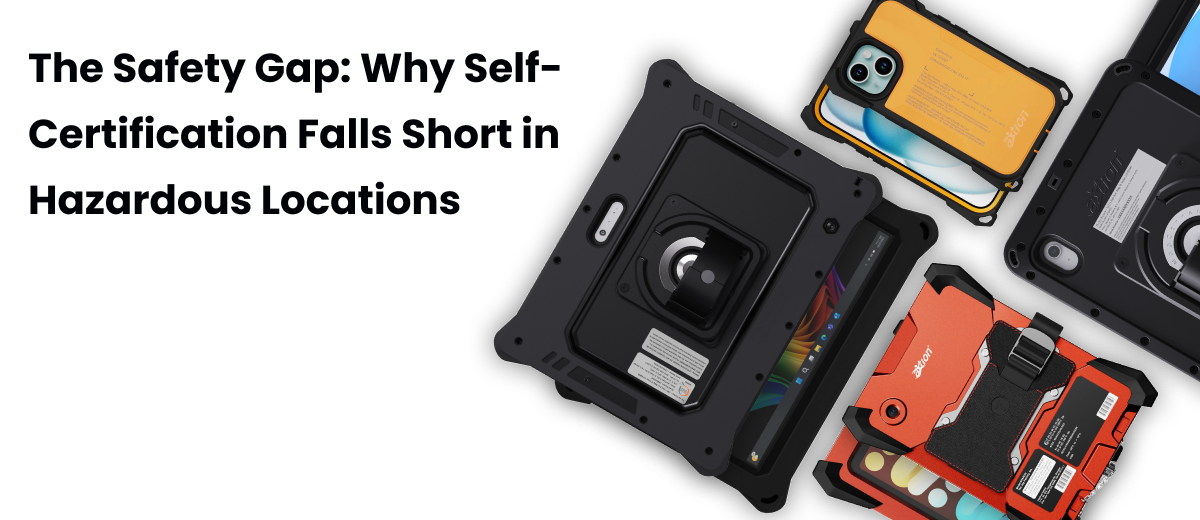
The most reliable approach today is leveraging the industry expertise of technology providers that protect and certify devices for use in hazardous locations. Unlike self-declaration, Nationally Recognized Testing Laboratories (NRTLs) act as independent bodies to ensure compliance.
Through rigorous testing and stringent certification protocols, NRTLs ensure that both the device and its enclosure are properly suited for their intended use.
While the overall deployment process with certified devices may be more complex than a self-certified alternative, the overwhelming benefits are too numerous to count. None is more important than the safety of precious human capital.
3. The Future of HAZLOC Safety
Ultimately, the direction of certified HAZLOC devices is leaning heavily away from self-declaration.
The industry is moving toward manufacturers who commit and invest in the requirements to prove their solutions meet the standards through third-party certifications. To ensure safety for workers and facilities, this is a much-needed progression in the journey of digital transformation.
Is your deployment strategy relying on judgment or certified proof?
Explore Certified HAZLOC Solutions
Explore Rugged Protection for Surface & Apple Devices
- Browse Our aXtion Rugged Cases – Explore our full lineup of rugged cases and mounts.
- Request a Demo – See how our solutions perform in your environment.